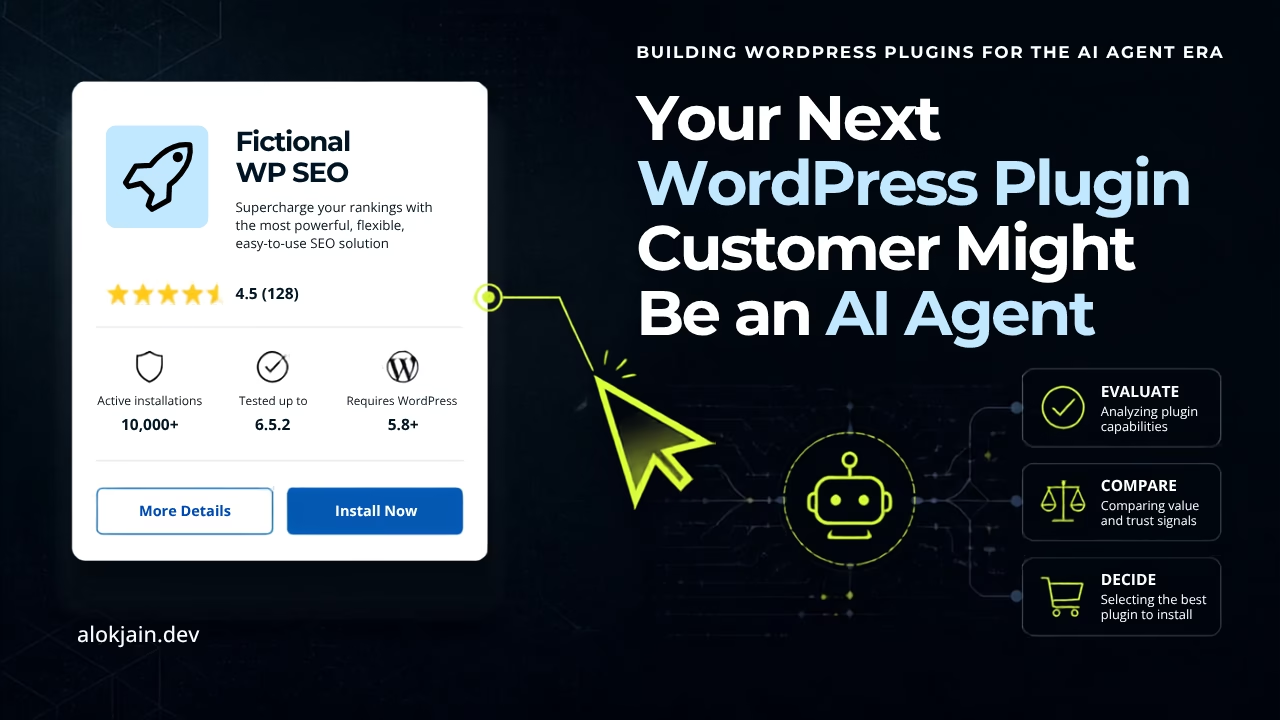
For years, selling a premium WordPress plugin has followed a predictable path. Someone has a problem, searches Google, reads a comparison article, checks a few plugin sites, and picks one. Search “best WordPress form plugin” and you’ll see the pattern immediately.
That journey is starting to split.
Increasingly, the person building the site never searches for a plugin at all. They tell a coding agent:
Build a custom WordPress site for a local business. I need SEO titles and descriptions, XML sitemaps, Schema markup, and Open Graph tags.
Now the agent has to decide. Build it from scratch? Recommend Yoast or Rank Math? Look for something more developer-focused? And if you’ve just launched a plugin, how does the agent even know it exists?
From search engine optimisation to agent discovery
Traditional SEO isn’t going away. People will keep googling, browsing plugin sites, watching YouTube reviews. But AI adds a layer between the customer and the product.
The old path:
User → Google → plugin website → comparison → purchase
The new one can look like:
User → AI agent → requirement analysis → plugin selection → implementation
The difference matters because an agent isn’t searching for the same things a human is. “The most powerful WordPress SEO plugin for growing your traffic” works fine on a human. An agent has a narrower question: does this plugin satisfy a specific set of technical requirements?
- Does it support custom post types?
- Can metadata be changed programmatically?
- Does it work with WooCommerce?
- Is there a PHP API? REST API?
- Which WordPress and PHP versions does it need?
- What does it cost?
That’s a different kind of evaluation than “sounds trustworthy.”
A fictional plugin to work through this with
Throughout this series I’m using a made-up plugin, FictionalWPSEO. It doesn’t exist, it’s a stand-in so we can talk about real architecture without pretending to review a real product.
Say it’s a solid commercial SEO plugin: titles, meta descriptions, sitemaps, canonical URLs, Open Graph, Schema, redirects, WooCommerce SEO, developer hooks. Clean code, good performance, fair price. We launch fictionalwpseo.com and wait.
Now someone tells an agent:
I’m building a custom WooCommerce site. I need an SEO plugin that lets me programmatically modify product metadata and Schema.
Does the agent recommend FictionalWPSEO? Probably not. That’s where this series starts.
A good plugin isn’t enough
The agent first has to know FictionalWPSEO exists. But discovery alone doesn’t get you there. Say it finds the homepage:
The Ultimate WordPress SEO Plugin
Supercharge your rankings with the most powerful, flexible, easy-to-use SEO solution for WordPress.
Perfectly normal marketing copy. But the agent hasn’t learned much from it. Nothing about whether it can modify a WooCommerce product’s Schema programmatically, nothing about a PHP API, WordPress version support, custom post types, or available hooks. Not even real evidence for “powerful.”
Three questions, really
I think about plugin readiness for agents as three separate problems.
Can the agent find it? Can search tools and AI systems reach your pages and documentation? Is anything meaningful crawlable? Does anything outside your own site mention the plugin at all? A product that only exists on its own sales page gives a new agent almost nothing to work with.
Can it decide when to use it? Finding you isn’t the same as recommending you. The agent needs enough to answer “is this the right tool for this project,” which means documenting capabilities, requirements, and limitations clearly enough for a machine to reason about. Instead of “Advanced WooCommerce SEO,” something like:
FictionalWPSEO supports WooCommerce Product and Product Variation post types. Title, meta description, canonical URL, and Product Schema can be modified through the PHP API.
Even better: say what it doesn’t do.
FictionalWPSEO doesn’t currently manage per-language sitemaps. Projects needing that will require an additional integration.
That reads like bad marketing. For an agent making a technical call, it’s exactly what’s useful.
Can it actually use it? Say the agent correctly picks FictionalWPSEO, and the developer says “add custom SEO metadata whenever a property listing is published.” If the docs just say “powerful developer tools,” the agent has to guess, and guessing produces invented function calls like fictionalwpseo_set_title($post_id, $title) that don’t exist. That’s not a model limitation. It’s a documentation gap. Give it a real, documented function and an example, and it stops needing to invent one.
Which gets at the principle running through the rest of this series: don’t make an AI agent guess how your WordPress plugin works.
This is bigger than “AI SEO”
You’ll see terms like GEO, AEO, and AI SEO thrown around this topic. Useful shorthand, but I think the real scope for WordPress plugin developers is broader. We’re not just trying to get FictionalWPSEO mentioned in a ChatGPT answer. We’re making the whole product legible to software: purpose, capabilities, limitations, requirements, documentation, APIs, examples, integrations. Eventually, maybe interfaces that let an authorised agent configure parts of the plugin directly. That’s a different project than ranking a landing page.
A paid plugin can still do all of this
One thing worth clearing up early: none of this requires open-sourcing the plugin. FictionalWPSEO is commercial. The code and download stay behind a purchase and license system. What needs to be public is enough for an agent to answer:
- What does the plugin do?
- When should it be used?
- How does a developer integrate with it?
- What APIs, hooks, and filters exist?
- What are the requirements and limits?
- Where’s the documentation?
After purchase, a coding agent working inside the project may also have access to the installed files. That opens a second opportunity: making the plugin itself easier for an agent to work with once it’s there. More on that later.
Where this is going
Over the next articles, I’ll take FictionalWPSEO from an ordinary premium plugin to one built deliberately for this environment: its documentation, how to describe capabilities so an agent can act on them, real code examples instead of forcing agents to guess APIs, AGENTS.md, llms.txt, structured data, crawler access, then deeper into architecture: machine-readable settings, PHP and REST APIs, OpenAPI, and eventually MCP-style integration.
And there’s a harder problem waiting at the end. Even if FictionalWPSEO does all of this perfectly, why would an agent recommend it over an established plugin with years of reviews, tutorials, backlinks, and community discussion? Making a plugin legible to AI is only part of the job. It also needs reasons to be trusted.
That’s the rest of this series.
Next: Can an AI Agent Actually Understand Your WordPress Plugin?